Showing posts with label Once Upon a Time. Show all posts

Sunday, April 21, 2013

Inconsistencies I have known.


graphic from:http://escapepod.org/2013/04/02/
tv-review-orphan-black/
Consistency.

It’s something writers strive for in their work, especially with respect to setting and character descriptions. For many, an error in consistency can break the narrative flow, reminding the reader s/he is immersed in a construct of reality and not the real thing.

On film, errors in consistency are typically referred to as bloopers. And though they can be fun to spot, if you’re like me, and the gaffes are serious enough, they can also be maddening. Minor consistency problems are artifacts of the way television and movies are filmed, a result of the final product being an amalgam of various takes and camera angles. This is the shirt that mysteriously buttons and unbuttons or the strand of hair that magically tucks and untucks itself from behind an actress’ ear as the scene plays out. In a recent episode of Cult, it was the level of water in Skye’s bottle that randomly rises and falls.

Errors like these are more amusing than annoying. The inconsistencies prompting me to write this blog are much more serious than that. The ones I’m talking about are due to errors in the writing and/or interpretation of the script, errors that should have been caught and edited out long before production began. Take, for example, the Once Upon A Time episode in which Mr. Gold/Rumplestiltskin is led to believe August is his son. This correlates with an hour of my yelling at the screen that August couldn’t possibility be Baelfire because August has blue eyes and Bae has brown. And while it turned out August wasn’t Bae, I don’t know how I noticed this and the boy’s own father didn’t.

Another issue arose watching this week’s Hannibal. The police assert that their murderer was killing girls of the same age, height, weight and with the same hair and eye colour as his daughter. They show a series of victim photos, and I swear the last girl has brown eyes. Trouble is, when they show the daughter in the next scene, her eyes are decidedly blue.

Perhaps the biggest gaffe I’ve noticed was in this week’s Orphan Black. I remember being told via subtitle in the premiere episode that the story takes place in New York. Wikipedia observes the police used NYPD coffee mugs and drove NYPD cars in that episode. But this week they drove to a building I recognize as being on the U of T campus driving cars with Ontario plates. To make matters worse, Sarah/Beth drove through Chinatown to get to a Kensington Avenue address and walked into The Waverly Hotel (it said so on the door as she entered). While I love that shows (like Rookie Blue or Bomb Girls) use Toronto as a backdrop for stories told in Toronto, I need a show to pick a location and stick to it so that I forget I’m watching a construct and not actual people’s lives.

In other words, do the viewers a favour and make the effort to remain consistent.

About the Author
Elise Abram, English teacher and former archaeologist, has been writing for as long as she can remember, but it wasn’t until she was asked to teach Writer’s Craft in 2001 that she began to write seriously. Her first novel, THE GUARDIAN was partially published as a Twitter novel a few summers back (and may be accessed at @RKLOGYprof). Nearly ten years after its inception Abram decided it was time to stop shopping around with traditional publication houses and publish PHASE SHIFT on her own.

Download PHASE SHIFT for the price of a tweet. Visit http://www.eliseabram.com, click on the button, tweet or Facebook about my novel and download it for FREE!

Monday, March 11, 2013

Strong Women on Television

Graphic taken from
http://www.empowernetwork.com
I love The Good Wife’s Alicia Florrick. At the start of the series, Alicia is a woman scorned. Her husband has cheated on her with colleagues and prostitutes, taking advantage of his position as DA, landing him in jail. Her relationship with her husband has changed over the years, from outright hate, to tolerance to friendship, but she remains strong. A strong female character makes sacrifices, and Alicia has sacrificed a sexy-hot relationship with Will Gardner for a sexy-hot no-ties sexual relationship with her husband, Peter, but she does so on her own terms. On her own, with neither Peter nor Will’s influence, she successfully wrangles a position as partner in her law firm after only 5 years’ employment. Alicia proves that being strong does not preclude being vulnerable. She proves a woman can be middle-aged and sexy, a care-giver, bread-winner, and mistress of her own sexual domain.

The kernel idea for this blog came while watching last week’s episode of Smash, which purports to weave together the lives of five strong woman, but falls short. Karen Cartwright begins the series as a mousy singer who is nearly willing to sacrifice her career for her fiancee’s, until he cheats on her with a Ivy. She follows director Derek around like a puppy on a leash (no offense, Katharine McPhee—you remain my favourite actor on the show in spite of this) and she is contemplating yet another relationship with her song-writer protoge, Jeremy, a drug user bent on self-destruction. Ivy Lynn nearly commits suicide over her affair with her director, Derek Wills. Julia Houston, the writer of Marilyn, loses her husband because she has an affair with a man she can’t resist and winds up losing them both. She will almost certainly fall for the “dramaturge” with whom she has been working the past few weeks. Veronica Moore is a teen Broadway sweetheart wanting to shed her little girl image and have the world recognize her as the woman she’s become, but is afraid to talk back to her mother who clings to Veronica’s little girl persona. Eileen Rand is the producer of Marilyn who battles with her ex-husband, Jerry, falls in love with a mobster who appears to have been hired by her ex to sleep with her and fund her project with illegal gains so she will have no choice but to hand the project over to Jerry (which happened last week). I’ll admit, I’m no Anjelica Houston fan, but she played what was perhaps the strongest female character on the Smash block up until last week which saw her plead to her boyfriend not to turn himself in to save her, a scene that was uncomfortable to watch as it came off as behaviour unbecoming to someone in Houston’s stage of life, bordering on simpering, which destroyed the remaining strong female character on the show.

Oddly enough, aside from Juliana Margulies’ Alica, the best examples of strong women on the tube these days are the “princesses” on ABC’s Once Upon a Time. Readers of my blog will know I am a diehard fan, but hear me out before you snort in derision at my claim. Cora, the miller’s daughter from the original Rumplestiltskin tale and Regina’s mother, tore out her own heart so she could follow through with her plan to rule the kingdom without being side-tracked by her love for the golden imp. Though Henry was born in prison because Emma fell prey to a man, she has grown into an independent woman that barely flinches when she learns Neal, Henry’s father, is engaged to another woman. She is too busy trying to cast spells to protect her family which, at this point in time, includes the dying Rumplestiltskin. Even Snow White steps up. Determined to protect her family at all costs, she curses Cora’s heart and manipulates Regina into placing it back into Cora’s body, thus killing her. Though many tweeted about how they hate Snow, I admire her for having the courage to sacrifice something of herself to protect those around her. Previously, Snow relied on Charming or Emma to protect her. Her sacrifice to meet Charming in the burning room was less altruistic than it seemed. Sure, she got him an important message that ultimately saved she and Emma, but the real reason she did it was to feed her lovesick heart and to see Charming again. Don’t get me wrong; I think casting Ginny Goodwin in the part of Snow White was a stroke of brilliance, but last night’s episode, which saw Snow make a decision that changed her innocent, child-like princess status to that of full-grown woman, finally rendered her character much more interesting than probably ever. Regina, the only other “strong” woman portrayed last night missed the mark this time, as strength does not equate with hatred, which has been the character’s drive for most of this season. Instead, her willingness to seek revenge has consumed her humanity, rendering her character much flatter than an actor the calibre of Lana Parilla should be tasked to portray. I hope the coming weeks see Regina gain more of the self-sacrifice of Alicia, the compassion of the old Snow, while echoing the pre-Rumple Cora, the woman with drive who fights against her vulnerability. If she is up to the task, Regina has the power to become one of the (if not THE) strongest female characters on television today.

About the Author
Elise Abram, English teacher and former archaeologist, has been writing for as long as she can remember, but it wasn’t until she was asked to teach Writer’s Craft in 2001 that she began to write seriously. Her first novel, THE GUARDIAN was partially published as a Twitter novel a few summers back (and may be accessed at @RKLOGYprof). Nearly ten years after its inception Abram decided it was time to stop shopping around with traditional publication houses and publish PHASE SHIFT on her own.

Download PHASE SHIFT for the price of a tweet. Visit http://www.eliseabram.com, click on the button, tweet or Facebook about my novel and download it for FREE!


Wednesday, February 13, 2013

I don't want realism. I want magic!

I listen to CBC Radio every morning on the drive to work. This morning I heard stories about how the number of home grown Al Qaida members is growing, the persistence of nuclear testing in North Korea,  the underfunding of aboriginal education in Canada, and (my personal favourite) a woman who says she can’t marry her beau of 15 years because the owners of a Spadina Avenue bridal boutique took off in the middle of the night with the store contents, her dress included.

That’s not what this blog is about. In the words of the immortal Blanche DuBois, this morning, “I don’t want realism. I want magic! Yes, yes, magic!”

Magic. What an apropos segue.

This morning I read Meredith Woerner’s post on io9 entitled “Once Upon A Time might be the most frustrating TV show I’ve ever watched”. Damn! She beat me to the punch. I vow from this day forward never to procrastinate writing and/or posting to my blog again. As Macbeth would say, from now on, “the very firstlings of my heart shall be the firstlings of my hand.” As a result of her post, I must change tack on mine.

I thought I might explode waiting out the three long weeks between  OUAT episodes. On second watch, I even grew to sort of like the subplot of the last episode as it was high time Dr. Whale got his backstory, though I still don’t understand what Rumplestiltskin was doing in 1800s Europe or why he wanted Frankenstein’s experiments to succeed. And while I admit Ruby and Whale might make a cute couple, I would much rather have learned more about Mr. Mendell, as well as seeing more Rumbelle interaction.

This week’s episode makes the third (to quote Ms. Woerner) of the most frustrating episodes I’ve ever watched.  I liked George Garcia, both in Lost and Alcatraz, but his role as “Tiny” the Giant seems forced.  Why grow “magic” beans if you have no use for them? If the purpose of the story is to introduce the stalk cutting to grow more beans so a portal back to Fairytaleland may be opened, isn’t there a better way? Secreted away in Mr. Gold’s safe, for example? And why return to Fairytaleland when it’s already been established that the kingdom and much of its surroundings is no more than wasteland?

Then there’s the matter of Regina. What happened to living a better life to prove to Henry she’s worthy of his affection? The whole time I watched the scene I thought, “this can’t be Regina; it’s Cora in disguise again.” I liked watching her struggle with her former self in an effort to change, though I realize now she can’t ever change, seeing as she’s a fairy tale character, drawn to power and…well…evil by design. The beauty of fairytales is the clear distinction between good and evil, the battle between the two, and that good always triumphs in the end. So while Regina had gained some headway into the gray, she must ultimately lose her battle as she is inherently evil.

On a brighter note, Hook, though still quite one dimensional, provided quite a bit of comic relief, coming on to everyone without a penis. Charming’s reaction to Hook’s advances on Snow were funny but exaggerated--when will the men of Storybrooke learn that if there’s one thing the women of Storybrooke don’t need it’s protection by Storybooke’s men?

Last on the discussion agenda is the story of Rumple’s search for Bae. In an earlier post I wrote that Gold had adopted his limp as an affectation to deceive people into believing he is weaker than he appears. Going by the way he limped through the metal detector, I’m guessing I was off base with that theory. I’m still holding tight to the theory that Bae is Neal—how else might the look of recognition on Emma’s face in the preview be explained?

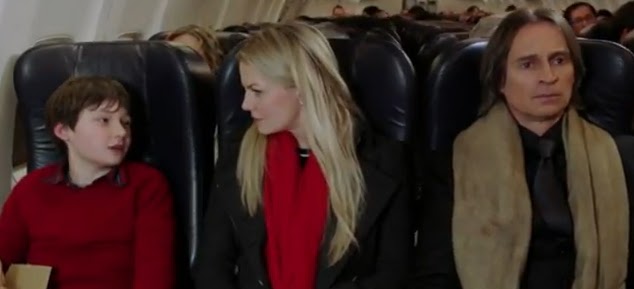
I like the fish-out-of-water vibe of Rumple at the airport and on the plane. In her post, Woerner asks, “Why not a road trip?” given that New York is probably no more than eight hours’ drive from Maine. When you consider that a plane ride might cut their travel time by half at least, they would save eight hours on a round-trip. That’s almost a day. A day less for Rumple to be away from Belle. A day less for Henry to be out of Storybrooke (though I don’t understand why he needed to go along on their quest). A day less for Emma to leave her parents (still naïve to the ways of the outside world) to deal with Mr. Mandell and Hook and Cora in her absence. 

Time to put on my English Teacher’s Hat now. The one thing this episode does is to seal the deal regarding Rumple as a tragic hero. In a previous post I explained how Rumple was an example of a tragic hero. He had everything in Fairytaleland—wealth, power, respect (disguised fear, really). In Storybrooke, his insistence that nothing has changed with respect to his power has slowly led to his downfall. He lost Belle (again). Power has shifted to Sheriff Emma and her parents. And now, he’s lost his magic, non-existent outside of Storybrooke, and his control. Sitting on the plane, we are reminded of Rumplestiltskin the coward, with one difference—this time, Robert Carlyle allows Rumple’s nobility to show through.

Next week should prove interesting. According to online spoilers, the flashbacks take us to early in Rumple and Milha’s relationship. In one picture, Rumple sits on a bed cradling baby Bae in his arms. One can only imagine the thoughts racing through the man’s head, his hopes for the child, but mostly his fears. Losing Bae’s mother to a pirate, nearly losing him to the Ogre Wars and then finally losing him to another dimension, his fear of the perils of Fairytaleland, mistaken for cowardice, prove warranted.
 
Works Cited
Woerner, Meredith. Once Upon A Time might be the most frustrating TV show I’ve ever watched. io9 TV Recap. 11 Feb 2013. .13 Feb 2013.

Download PHASE SHIFT for the price of a tweet. Visit http://www.eliseabram.com, click on the button, tweet or Facebook about my novel and download it for FREE!

Saturday, February 9, 2013

The Anti-Hero


I love Dexter, be it reading Jeff Lindsay’s novels or watching the television series. It was weird at first, rooting for the bad guy, but the more I read/watched, the more I realized that “bad” had shades of grey. Lately, many shows feature protagonists who are more anti-hero than hero. Take ABC’s Once Upon a Time, for example. It’s no secret that my favourite character on that show is Rumplestiltskin/Mr. Gold, a man who killed his wife, chopped a man’s hand off, held a woman hostage, and beat an old man with his cane, twice. Through it all, I root for him. I feel the loss of his son, the anguish in his love affair with Belle, the plunging psyche as he picked up the remains of his prized possession, the chipped cup, from the hospital floor. Scandal is another example. Olivia and her team have murdered, stolen, and lied. Olivia herself is in an affair with a married man and was involved in rigging votes in the last presidential election. Is it wrong to want to see her and Fitz together? To want Fitz to remain blind to her conspiracy? To want Mellie to die in childbirth? To love Cyrus for calling off the gun for hire he’d paid to murder his own husband to keep the secret buried?

For two weeks now, I’ve been watching FX’s The Americans. The premise is intriguing: Russian spies carrying out covert missions while posing as the all American family. As I watched this week’s episode, I questioned my interest in the show. Talk about anti-heroes? Elizabeth and Phillip pose as heads of a nuclear family, living out the American Dream in their house in the suburbs with their son and daughter. Last week, they used their garage to store the spy that raped Elizabeth during her training in the trunk of their car. This week, Elizabeth poisoned an innocent college student and the two blackmailed his mother for the cure. Elizabeth played the nurse to the boy while Phillip beat up the uncle, broke his hand, strong-armed the mother, and nearly suffocated the boy to get what he wanted, which was for the mother to plant a bug in a politician’s office. As I watched, I thought, “How horrible. I don’t even think I like these characters.” Then Phillip sat in his car after suffocating the boy and nearly cried while Elizabeth consoled him. I won’t say I root for him as I do Dexter, but I think I watch to put together the glimpses of humanity. So long as the gruesome brutality is balanced with the humanity, I may continue to watch.

I am no stranger to television brutality. Shows like True Blood, Vampire Diaries, and Walking Dead are full of it, but the macabre is acceptable, almost expected, given that the characters are vampires and werewolves and hunters and zombies and just trying to survive. Shows like this don’t bother me much. What I find horrific is when the monsters are human, drawing blood for nothing more than the horror of it. Dexter, I understand. He witnessed his mother brutally murdered in front of him as a toddler. Dexter’s impulses are born of blood. He knows what he does is wrong. Unable to quash his compulsion, he has found a way to control it instead, killing only those who deserve to be killed. Not the same for Joe Carroll on Fox’s The Following, who gets others to kill for him a la Charles Manson. I can’t figure out why he does what he does other than the fact that he can. American Horror Story is another show that pushes the blood-soaked threshold, but it does so with a subtle irony and hidden horror stereotype allusions that elevate it from horrific bloodbath to interestingly compelling.

The line between good and evil has blurred for the traditional superhero types as well. Gone are the days in which the hero does good both in and out of their costumes, like Batman or Superman. Today’s heroes fall nothing short of human. This week’s Arrow, for example, showed Oliver brutalizing his own mother for answers. On Person of Interest, Detective Carter often bends and/or breaks the law to save Reese and Finch. Even the president of the United States is not exempt—this week’s Scandal saw Fitz murder Verna in her hospital bed to prevent the jury tampering secret from getting out. Gone are the days of good and evil, of black and white; welcome to the days of anti-heroism and shades of grey.  
 
Download PHASE SHIFT for the price of a tweet. Visit http://www.eliseabram.com, click on the button, tweet or Facebook about my novel and download it for FREE!

Monday, January 14, 2013

A Tale of Two Villains


Once Upon a Time Season 2, Episode 11 Behind the Scenes: Colin O’Donoghue (Captain Hook), Robert Carlyle (Mr. Gold/Rumplestiltskin), and Emilie de Ravin (Belle)
Photo from http://www.wetpaint.com/
once-upon-a-time/gallery/
once-upon-a-time-behind
-the-scenes-pics-season-2-
episode-11-the-outsider-photos#5

The Once Upon a Time showdown we’ve all been waiting for unfolded last night, and it did not disappoint.


Last night’s episode, “The Outsider”, might have been subtitled “A Tale of Two Villains”, as it pitted Hook against Rumple in a battle, both of wit and strength. Hook, who puts Belle in danger to get Gold out of his shop so he can steal a shawl, Rumple’s prized possession, thinks with his head. Ordinarily, I would argue Hook is no match for The Dark One who pens iron-clad contracts, tricking those with which he bargains into thinking wish fulfillment is within their grasps. But this is not the old, lonely, bitter Rumple. Forging a relationship with Belle whilst believing a reunion with his son is within reach, Rumple is vulnerable. When he saves Belle on The Jolly Roger, he turns his anger on Hook, playing into his trap. The beating he inflicts on the pirate is both disturbing and comic; Belle’s reaction both touching and foolish.

Colin O’Donoghue plays Hook with slimy, sexy, smarminess. His proximity to Belle while threatening her on The Jolly Roger is both scary and (for lack of a better term) hot. But the real showstopper is Robert Carlyle in the role of Rumple/Gold. I melted when, after Belle is trapped in the elevator by Hook, the doors open to reveal Rumple and he and Belle hug. I cringed throughout Hook’s beating, reminiscent of a similar assault perpetrated by Gold on Moe French in season one. I grew excited at the prospect of Rumple in the real world after he crosses the town line and my brain began forming scenarios as to how the search for his son, Baelfire, might play out.

The last minutes of the episode are demonstrative of how a true cliff-hanger should play out. Belle shot. Rumple’s hand covered in her blood. A speeding car. Rumple dropping and rolling he and Belle from harm’s way. Hook hit. Brilliant. The one thing with the ability to top this: next week’s trailer. In the clips, an unconscious Belle lies in her hospital bed. Thinking, no doubt, she will awaken after sharing true love’s kiss, Rumple kisses her. Belle opens her eyes, sees Rumple, and screams, recoiling as she does. The implications are gut-wrenching and exhilarating at once. Oh, and let’s not forget the backstory clip that shows Rumple kissing Cora, which raises the obvious question: could Rumplestiltskin be Regina’s birth father? Is that why he took her under his magical wing?

On the deck of The Jolly Roger, Hook sums it up best when he tells Gold he looks more like the coward he remembers. Rumple, the man, is at his most vulnerable when he has something to lose. Branding him as The Village Coward was unfair. He ran from battle during The Ogre Wars because he had something to live for (his wife and child) and didn’t want to die. He gave fealty to the soldier in front of his son because he wanted to escape and get Bae to safety. He didn’t fight Hook in Storybrooke because he knew they were no match, so he appealed to his sense of decency (which, unfortunately, Hook failed to cultivate) instead. As The Dark One, he had nothing to fear. Finally, he had the means to protect his son. When Bae was lost, he was free to pedal his deals, searching for a way to be reunited with his son all the while.

Belle represents Rumple’s vulnerability personified. When he thought she was dead, he was strong. Since she’s returned, it’s been amusing to watch Rumple embrace his reluctant weakness, sparring with his inner-coward as it threatens to bleed through his hardened exterior. With Belle removed from the equation, will Rumple lose himself in The Dark One once more? Will Rumple be cashing in Emma’s favour IOU? Was Neal the driver of the car? Was it Bae? Are the two one and the same?

Next week’s episode is entitled “In the Name of the Brother”. Speculation has been this episode will focus largely on Dr. Whale/Frankenstein and his family. While I think this is an interesting tangent, much like last night’s Yaoguai tale, I hope they don’t lose sight of the Hook/Belle/Rumple triangle, which in my humble opinion, is much more interesting than the Snow/Charming saga.

I wait with you and bated breath ‘til next Sunday.

Download PHASE SHIFT for the price of a tweet. Visit http://www.eliseabram.com, click on the button, tweet or Facebook about my novel and download it for FREE!


Sunday, December 30, 2012

Behind Every Story is a Kernel of Truth

The desire to own a part of history is probably as old as man himself. Reality television is replete with shows—Canadian/American Pickers, Pawn Stars, American Restoration and the like—that attest to this. The Victorians were obsessed with all things Egyptian. It wasn’t uncommon for the wealthy to purchase and display mummies in their own homes or host mummy unwrapping parties (History), the craze for which continues and was documented in the short-lived television series Treasure Trader. Anything ancient, it seems, is worth collecting, even fossilized dinosaur feces, which was recently sold at auction on Auction Kings (Discovery).


The problem with procuring artifacts such as these (though technically, the dinosaur poop cannot be called an artifact as it was not manufactured or modified by people—unless you call the turning of the fossil into a commodity a modification) is that it is regulated. There are laws in place regarding who may legally excavate these materials. And make no mistake about it, picking an artifact up from the ground knowing it is from a potential archaeological (or paleontological) site is considered excavation, even if it the item lay on the surface when you found it.

I can remember in the early days of the Internet finding a bottle collector’s website. Though he posted some amazing diagnostic tools, his site read, primarily, like a how-to for bottle hunters. As a practicing archaeologist, I engaged the man in a digital debate that I had no expectation of winning. Though I tried to educate him on the evil of his way, the man relied on his pot hunting to make a living. One has to look no further than SpikeTV’s American Digger to see how to do this for a living.

I was an archaeologist for about a decade of my life, and though I can say that in those ten years I never worked on a site that had been vandalized, I was sickened at the stories I heard from my colleagues. Most of my work was on public archaeological sites. This meant the sites were open to the public with the intent to educate them on the importance of the archaeological record. Unfortunately, most people didn’t get the lesson we were trying to teach. In PHASE SHIFT, the main character, archaeologist and university professor Molly McBride laments,

On archaeological sites someone always comes around and asks if you’ve found any gold yet. It’s inevitable. Tell me something, I’ve always been dying to say, when you move house how much gold do you leave behind? Instead I smile, and try to educate them on the fact that archaeology is not about the money. What’s more valuable is the information artifacts give us about what went on while the site was occupied all those years ago, regardless of their material of manufacture.
An observation that’s altogether too true. When I worked on The Trinity Bellwoods/Gore Vale Site in downtown Toronto, almost once a day someone would come by and ask if I’d found anything valuable yet. My own grandfather used to tease me about this each and every time he saw me, something which exasperated me to no end. In case you’re wondering, I never did find any gold and any of the coins I found were too old and too damaged to have been worth much of anything.

The nugget for this blog was mined from an article published on the LiveScience website about a fossil dealer who was prosecuted for smuggling dinosaur remains. The article reminded me of the stories I’d heard regarding plundered Ontario archaeological sites and how powerless archaeologists felt to do anything about it but to hire round-the-clock security guards on an already stretched budget (something Molly does to protect the TTC site in the as yet unpublished THE NEXT COMING RACE). Prosecuting looters is a difficult task as it is tough to prove in court as it often happens under the cover of night and without witness. In 1985 the July/August issue of ArchNotes carried an article by William A. Fox documenting the first case of the successful prosecution of looters to a site, but that case involved witnesses and police involvement. Had the looting been carried out by a stranger rather than a neighbour of the property owner, the case might have ended differently.

When I read the LiveScience article, I thought of the first chapter of THE NEXT COMING RACE, the book to follow the recently published PHASE SHIFT. In it, protagonist Dr. Molly McBride enlists local archaeologists to participate in cyber-stalking to determine when local bands of pot-hunters will loot abandoned sites in order to conduct raids to scare them off in an attempt to protect the archaeological record. As this is the first chapter in the novel, it sets into motion the main plot and the threads of two sub-plots that (I promise) eventually come together and make sense in the long run. The main plot supposes an archaeological site is found during the excavation for expansion of Toronto’s subway system. The sub-plots are the raids on the looters and Palmer’s involvement in a case of forensics with the police department. Please click on the link to read, and enjoy.

If you like Molly and Palmer, you can download PHASE SHIFT, my first published novel featuring these characters from my web site, eliseabram.com, for the price of a Facebook post or tweet. Molly and Palmer are also featured in two novellas available at KoboBooks.com or Amazon.com entitled THE MUMMY WORE COMBAT BOOTS (largely about Palmer and DC Michael Crestwood), and THROWAWAY CHILD (featuring Molly, Palmer and Michael). Happy reading.

Note for Once Upon A Time fans: I cast my characters when I write in order to help me imagine the scene as well as to keep my character descriptions consistent throughout a work. As you read this chapter from THE NEXT COMING RACE, try to imagine OUAT’s Robert Carlyle in the role of Dr. Palmer Richardson and (not an OUAT alumni, but he played Lois Lane’s father on Smallville and has been a favourite Canadian actor of mine since the first V series) Michael Ironside in the role of DC Michael Crestwood.

Works Cited
Discovery. Auction Kings: Dino Poo. 2012. . 30 December 2012. (Video)

Fox, William A. The Freelton/Misner Site Looting and Prosecution. ArchNotes. July/August 1985. . 30 December 2012. (Newsletter)

History. Mummy Unwrapping Parties. 1996-2012. . 30 December 2012. (Video)

Parry, Wynne. Dealer Pleads Guilty to Smuggling in Largest International Dino Case Ever. LiveScience. 29 December 2012. . 30 December 2012. (eZine)

Monday, December 24, 2012

A Fan is an Enthusiastic Devotee...

When I was younger I was, admittedly, a fan girl. I can remember having more than 200 pictures of Gregory Harrison posted on my bedroom walls when I was twelve. As a teenager, it was Simon LeBon of Duran Duran. I’ve seen them in concert a total of four times and own every album they’ve ever recorded. Ditto The Human League. But those were the days before the advent of The Internet, when the only fans you connected with were your friends or the people in the audience. Though we argued over whether Simon was hotter than Roger or Nick, there was no debating our love for the music.


I’m also a Star Trek fan. I collect memorabilia, everything from action figures to decorative plates. I’ve watched every television episode and movie multiple times and connected with actors and other “Trekkers” at conventions. We disagree over which Trek is best, which captain is most commanding and whether Romulans or Klingons have the ability to kick the most Federation butt, but the atmosphere at these gatherings is congenial.

My first foray into online fandom occured nearly ten years ago now I joined Nick Mancuso’s Yahoo group, which ultimately led to my meeting the actor, an experience which I will never forget. While I was active in the group, I was surprised at the vehemence many of the fans brought to it. Though we knew the actor tuned in from time to time, some of the members felt no compunctions posting unfavourable criticisms of his work, critiquing his choice of scripts and his acting ability in a voice that could be described as anything but constructive. Other members used the group as a forum to spew racist remarks at which some of the fans (including myself) took umbrage to the point of bowing out of the group. At times I was surprised Mr. Mancuso didn’t do the same.

The idea for this blog post came after a similar experience regarding fans of ABC’s Once Upon a Time in which people who are so passionate about the show they are willing to post artwork, fan fiction, critiques and predictions about it online for the whole world to see, only for some to be shot down for their admiration in the most horrific way.

In planning for this blog, I returned to the dictionary definition of “fan”, which is: “an enthusiastic devotee, follower, or admirer of a sport, pastime, celebrity”. Dictionary.com pinpoints the origin of the word to 1885-1890 as an “Americanism; short for fanatic”. Synonyms include “supporter, enthusiast [and] addict”. Another definition it gives is “a person with an extreme and uncritical enthusiasm or zeal” (emphasis added).

What strikes me as most interesting about this definition is the synonym “addict” and the fact that a fan typically has an “uncritical” zeal. Many people who blog about OUaT are anything but uncritical, both of the show and of their fellow “fans”. Everyone is entitled to an opinion, and as an opinion is made with insufficient grounds to produce complete certainty (dictionary.com), an opinion can never be wrong. An opinion can be formulated based on ignorance or misinterpretation of fact, but it can never be wrong because, by definition, it is based on uncertain grounds. What this means is that if I thing Belle and Hook would make a better ship than Belle and Gold, that’s my opinion. You can disagree, but I am not wrong because this is my personal view. (I don’t by the way. I so love seeing Gold thrown off kilter as he tries to figure out how to win and keep Belle’s favour.)

As a mature adult, I may think that someone is off his rocker for even suggesting Belle be shipped with anyone other than Gold, but I must voice my opinion in a way that expounds my personal view without personally attacking anyone whose opinion differs from mine. This all goes back to my previous post which discussed online personas. I can make a name for myself as a diplomat who is willing to engage in an adult discussion of fact without devolving into schoolyard name calling, or I can make a name for myself as a foul-mouthed, narrow-minded dictator who is unwilling to allow for any opinion other than the one I’ve formed for myself. As I told the student who used Twitter as a sounding board which included a lot of unkind epithets directed at my teaching ability, there are ways to express your frustration without resorting to swearing and personal attacks.

I love the online debate that ensues as a result of the twists and turns Kitsis and his staff throw at OUaT’s fan base, but I could do without the swearing, name-calling and personal attacks. And while I’m sure those who see themselves in this blog will no doubt take umbrage in its posting and wind up throwing a few of those epithets my way, I am, like so many of you out there, sticking my neck out to post this nevertheless.

I leave you with the following two quotes, which I think sum this post up nicely:

Can we all get along?” (Rodney King, I believe)
If you can’t say something nice, shh, say nothing.” (Thumper)

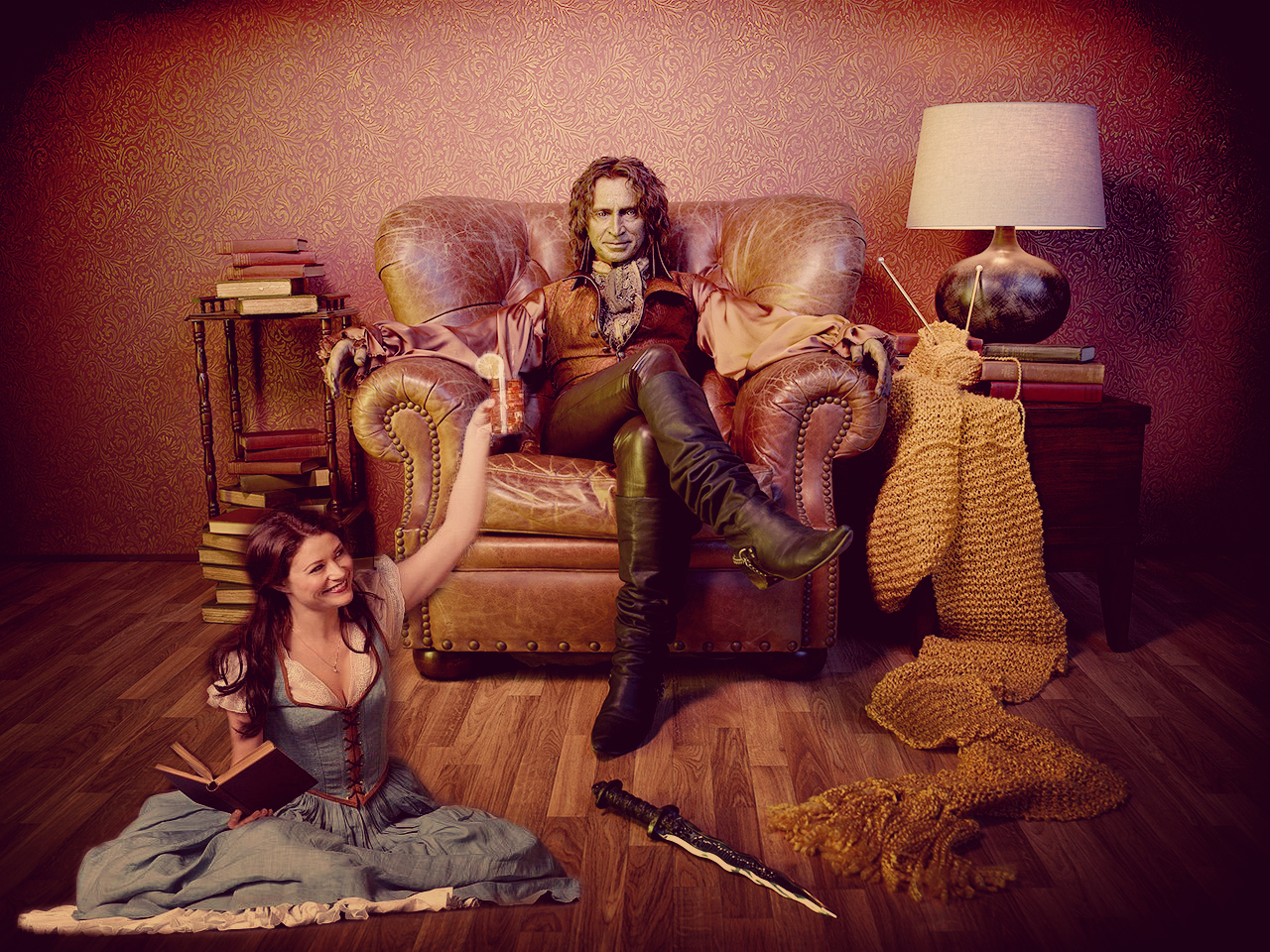
Graphic from http://images6.fanpop.com/image/photos/32300000/Rumpelstiltskin-Belle-once-upon-a-time-32348825-1280-960.jpg

Wednesday, November 28, 2012

A quest! A quest! My kingdom for a quest!

The November 25th episode of Once Upon A Time was exciting for many reasons, the least of which was not in watching Robert Carlyle bring yet another facet to the diamond in the rough that is Rumplegold. I was fascinated as he tried to be demure on his date with Belle at Granny’s Place in spite of the dirty looks and evil eyes Storybrookers shot his way. Thoroughly enjoying was the way he continued to protest his power as being greater than both Regina’s and Cora’s though he no longer had the bluster to back it up. But that’s not the subject of this blog. This blog is about The Quest Archetype and the skilful way the writers weave it into the plot of the story.


Just as a tragic hero has a set of parameters that, once satisfied, a character may be classified as such, so, too does a quest. The Quest Archetype (as defined by Joseph Campbell, American mythologist, writer and lecturer (Wiki)) may be defined as:

begin[ning] in the hero's ordinary world, when he or she receives a call to adventure from a herald. Many heroes initially refuse the call, until a mentor reassures them that they are capable. After this meeting with the mentor, they must enter the world of the quest. They meet allies and enemies along the way and are tested frequently. As they near the source of their quest, they usually face one final ordeal. Upon their success, they take the object of their quest, and make their way home. The way home is not always easy, but eventually they return to their ordinary world with their prize (PBS).

The OUAT quest begins in our world, an ordinary world that normally doesn’t have any magic. Emma Swan is the heroine of the story who is drawn to Storybrooke by her son who assures her she is the key to breaking the curse under which they all live. Emma resists, refusing to believe she is their saviour but eventually is convinced by Snow White/Mary Maragaret, who plays the role of Emma’s birth mother and mentor, who reassures her she is capable. She comes to believe this when she saves Henry from Regina’s sleeping potion and slaughters Maleficent in her dragon form to retrieve the potion that will break the curse. The true quest begins when both Snow and Emma wind up back in Fairytaleland—the world of the quest--and they are tasked with finding a way to get back home.

The secret to getting back to Storybrooke lies in an old compass and the ashes from the tree/wardrobe that originally transported Baby Emma to Storybrooke. Snow and Emma meet allies—Mulan and Aurora—and enemies—Cora and Hook—along the way and are tested frequently. One such test occurs when Hook takes Aurora’s heart and Cora uses it to convince the heroes that Hook wants to help them in their quest and that he may even have a little crush on Emma. Another is when Aurora is taken by Cora and Mulan takes the compass to get her back. Still another happens in the previous episode when Emma has to take the compass from the Giant residing at the top of the beanstalk. It is anyone’s guess what the final ordeal will be or when it will occur, but if the writers remain true to form, the heroes will emerge from the ordeal successful and find their way home to the ordinary world.

The only question remaining (and I can’t wait to see how it all pans out) is if Cora and Hook will follow.

Works Cited

PBS. In Search of Myths & Heroes. http://www.pbs.org/mythsandheroes/myths_archetypes.html. 28 Nov 2012.

Wiki. Joseph Cambell. Wikipedia: The Free Encyclopedia. 21 Nov 2012. http://en.wikipedia.org/wiki/Joseph_Campbell. 28 Nov 2012.


Sunday, November 4, 2012

Rumplestiltskin as Tragic Hero

The classic definition of a tragic hero according to Arisotle is that he must be of noble birth, has a tragic flaw which leads to his downfall, suffers a reversal of fortune, his actions bring about an increased sense of self-awareness and self-knowledge and the audience must feel pity and fear for the character(1). I submit that Rumplestiltskin, aka Mr. Gold on ABC’s Once Upon A Time (OUAT) is a tragic figure. While he is not of noble birth, he does have a tragic flaw (cowardess) which leads to his downfall, he suffers numerous reversals of fortune (the loss of his son, wife, and lover), his actions bring about an ongoing increased sense of self-awareness (recent confessions made by the character), and the audience feels both pity and fear for the character.


For those of you who aren’t familiar with OUAT, the show is about storybook characters coming from their familiar storybook existence in Fairytaleland (FTL) to our world and settling in Storybrooke, Maine (SB). Robert Carlyle plays Rumplestiltskin in FTL and Mr. Gold in SB with menacing relish. In the original tale, Rumplestiltskin is an impish character that is able to spin straw to gold. He agrees to teach the miller’s daughter the trick, provided she pay the sum of her first born to him. The miller’s daughter marries the king and has a child but does not want to give it up. Unable to resist a deal, Rumplestiltskin agrees to let her keep the child, provided the (now) queen can guess his name. After the second try, certain that he would receive the child, he was praising himself by the fire when someone heard and reported his name to the queen. Upon hearing his name come from the queen’s lips, Rumple got so angry he tore himself in two (2). In OUAT’s version, Rumple is the village coward. Shunned by others in his village because he ran when the ogres attacked rather than fight, his wife (Milha) has run off with Killian Jones (aka Captain Hook). Determined to become powerful and earn the trust of everyone including his son, he kills The Dark One and assumes his powers. Shunned by others because they fear him, he saves his son from fighting in The Ogre Wars only to lose him when he falls into a portal to another land and closes before he can follow. Alone, he finds his wife and kills her by literally taking and destroying her heart. Lonely, he makes a deal with a king to save his subjects from the ogres in exchange for his daughter, Belle, with whom he falls in love. Believing himself unworthy of being loved, he banishes Belle from his castle and Regina, The Evil Queen, convinces him she returned to her village despondent and ostracized for her involvement with him and she kills herself. After Regina enacts The Curse causing FTL characters to be transported to SB, he finds Belle when the curse is more changed than broken and reunites with her, but finds it hard to shake his beastly ways.

The Tragic Hero is of Noble Birth

Granted, Rumple himself is not of noble birth, but he does become elevated to the status of nobles when he becomes The Dark One. He has the same powers and wields them to his advantage as do the other royals in FTL. Take, for example, King George, who takes a peasant boy to replace his son when he dies only to threaten his mother and his twin brother’s life if he does not do the same when the replacement dies. Or Belle’s father, Sir Maurice, who is willing to trade his daughter for peace in his kingdom (granted Belle decides to go on her own, but in the long run, Maurice remains passive when his daughter leaved). Then there’s Regina who pushed her mother into a portal and has made her life’s mission to wreak havoc in Snow White’s life for a transgression occurring in her childhood. Like the other royals, Rumple is feared for his power and revered by those who come in contact with him by people who offer (as Macbeth, another royal and tragic hero laments) “mouth-honour”. As the owner and benefactor of SB, Rumple, aka Gold, maintains his power over the characters and seems to enjoy that they fear him. He is the proprietor of the local pawn shop which houses many of the character’s prized possessions with which they made deals with Rumple back in FTL.

The Tragic Hero has a Tragic Flaw Which Leads to His Downfall

As far as personality flaws go, Rumple has many. The story begins with him as a coward, then becoming addicted to and drunk with power as The Dark One. He clings to this power, valuing it even over the love he seeks. This is demonstrated when, after his magic seems threatened by Belle’s love for him, he sends her away rather than explore his heart’s deepest desire. Betrayed by many including his wife, his apprentice (Regina) and many of the townspeople when they try to get out of the bargains he strikes, Rumple trusts no one. Rumple’s biggest flaw is his desire for acceptance and love. He places himself in a vulnerable position when he allows himself to mistake August (aka Pinocchio) for his son, and again when he prostrates himself to Belle in the library after admitting to her he is still a coward. It is this flaw more than the others that will ultimately lead to his downfall, as a man as powerful as RumpleGold cannot afford to wear his hat on his sleeve in such a manner.

The Tragic Hero Suffers a Reversal of Fortune

When Rumple agrees to kill The Dark One in order to release him from his misery and gain his power, he thinks life can only get better. Rather than ostracize and ridicule him as being the village coward, the villagers will be forced to revere him or he will turn them into a snail and crush them like the bugs they are. Instead, people ostracize him further. Instead of their disgust, he garners their fear. If he is The Dark One, he surmises, his wife will beg to come back to him and he will win back his son’s respect. Instead, he loses them both. Perhaps worse, he loses himself in the bargain. As we have seen with Regina, magic is addictive. In a brilliant turn of events, Regina runs to psychiatrist Archie Hopper (aka Jiminy Cricket) when she falls off the magic wagon. Like Regina, Rumple is addicted to magic. He does not know how to interact with others without offering them some sort of magical deal and, as previously stated, he chooses magic over securing his deepest heart’s desire. It seems to me that there is no lower ground to which a man who kisses a soldier’s boot in front of his son can stoop, but Rumple seems to do it. At times I am left to wonder, which is better—being ridiculed for cowardess but still having my son, or having all the power in the world at my fingertips and being utterly alone in, not one, but two, worlds.

The Tragic Hero’s Actions Bring About an Increased Sense of Self-awareness and Self-knowledge and the Audience Must Feel Pity and Fear for the Character

As writers continue to flesh out Rumple’s character, we learn he is very much self aware. The mystery in season one questioned who, out of all of the characters, remembered their FTL past. I love the scenes in which Rumple and Regina verbally spar. In one of these scenes, Rumple is in SB’s jail and Regina is compelled to sit and talk to him (she must do whatever Rumple says when he says “please” as a part of the original curse). The moment where he reveals he remembers his FTL name is an incredible step toward his admitting he is still The Dark One and the audience can’t help but fear what will happen to him if the others regain their memory and learn of his name. In season two, the Rumbelle ship continues to sail on very choppy waters. As they battled a wave that threatened to sink their ship, Rumple admitted to Belle that he is still a coward. What a brilliant moment toward Rumple’s self-awareness of the man behind the beast. At that moment, I felt nothing but pity for the character played to expertly by Robert Carlyle. He still loves her. And in admitting that he needed her, he revealed a vulnerability that instilled fear in audience members such as myself who watch the show primarily for this character. Many in the blogosphere believe that Hook will seek revenge for Rumple’s killing Milha on Belle. Having begun his descent out of the pit that is his addiction to magic, I can’t help but fear that without Belle he will fall back to magic to seek his own retribution, and thus descend into madness as well.

Time, of course, will tell, and I don’t mean time on the clock swallowed by the crocodile in the original Peter Pan tale because in OUAT’s version, Rumple is the famed crock as well. As I write this, Hook and Emma, still trapped in the ruined FTL are about to discover Jack’s beanstalk in their quest to find a portal to SB so Emma and Snow can be reunited with their family and Hook can “skin” the crock that took his hand and his love. My hope for Rumple is that he remains intact for the balance of the series, however long that may be, and not fall prey to the death visited on most other tragic heroes at the end of the tale.

(1) http://shakespeare.nuvvo.com/lesson/4435-elements-of-a-tragic-hero-in-literature

(2) http://www.eastoftheweb.com/short-stories/UBooks/Rum.shtml

Monday, October 22, 2012

Flat and Round

http://hollywoodlife.com/2012/10/21
/once-upon-a-time-captain-hook-
rumpelstiltskin-kills-milah/
Colin O’Donoghue who plays Killian Jones aka Captain Hook in ABC’s Once Upon A Time is handsome, I’ll give him that. The blogosphere was abuzz with how Hook will give Rumple a run for his money, how he will be the biggest and baddest villain on the show. The problem with these theories is that Hook is flat whilst Rumple is rounded. Hook will be no match for Rumple due to Rumple’s multifoliate interior.

Characters are of two types, flat and rounded. Flat characters are doomed to live their lives out in Flatland, the one-dimensional world created by Edwin A. Abbott and popularized by Sheldon Cooper in an early episode of The Big Bang Theory. That is to say, when looked at head on, they have shape and dimension, an appearance, names, a purpose, but when they turn sideways, they devolve into nothing more than flat lines, indistinguishable from one character to the next. Flat characters function as “phaser bait”, they serve a purpose, nothing more. They are the innocents Palmer and Michael (my characters) interview in their investigation that give up their information and then vanish, never to be seen or heard from again. They are Molly’s students who find an important artifact and then get about with their studying. They are the pirates who cheer on Hook in his bid to belittle Rumple and then fade into the background. They are the Milhas, the women who spur a duel between two characters, never to be heard from again. Last night’s Hook seems to have no motivation other than to kidnap women for the pleasure of he and his crew and then, later, to avenge Milha’s death. Or maybe it’s to get back at “The Crocodile” (a brilliant turn of events, nicknaming Rumple this) for taking his hand. OUAT’s Hook is narcissistic, and single-minded. Girls and wealth are his only motivator.

Ever the round character, Rumple continues to amaze. All this time, the viewer was led to believe his sole motivation was to bring magic to Storybrooke so he could wield power over Regina, The Evil Queen. Now we learn his sole purpose is to overcome his cowardly past, to be reunited with those he loves and prove to them he is worthy. In a stroke of genius, the writers send Rumple to Belle to humble himself and apologize for his transgressions where she is concerned. He is a man who knows he is imperfect, someone who is capable of vengeful murder (Milha’s) and sweet gestures (giving Belle the key to the library), but at his core, he is a man whose sole desire is to be loved, and to love, but he doesn’t know how. Rumple looks upon people as possessions. He became The Dark One to keep Bae with him. He killed Milha (his wife) because he could not possess her. He imprisoned Belle in his dungeon because he feared she, like all those before her, would leave. Rumple’s motivation to bring back magic so he can leave Storybrooke and find his son is heart-achingly poignant and gives the character depth.

Granted, Hook is a new character and we’ve only seen him in a single episode designed to facilitate getting Cora, Emma and Snow back to Storybrooke, and he will be fleshed out in the weeks to come. But so far, the simple fact that Hook was introduced to facilitate getting Cora, Emma and Snow back to Storybrooke supports my theory that he is a flat character. He has a purpose; he has no self-motivation to speak of thus far. Contrastingly, when we are first introduced to Rumple, he is already The Dark One, his origins a mystery cloaked in an impish exterior. He is jailed, he grants wishes, he is hated and revered by virtually everyone in Storybrooke. We know there is an age-old rivalry between he and Regina and we ache to find out what that is. Juxtapose that with Storybrooke’s Gold who may or may not remember his life before the curse, and Rumplegold is multi-dimensional from the start.

Last night’s OUAT opened a multitude of possibilities for the season(s) to come. I like that, unlike while watching so much formulaic prime time tripe, I never know what to expect. And even when I intuit the formula, I am still satisfied with what I see. Kudos to OUATs writers and actors, but especially to Mr. Robert Carlyle who brings justice to the character of Rumplestiltskin, a tragic hero if ever one there was.
Download PHASE SHIFT for the price of a tweet. Visit http://www.eliseabram.com, click on the button, tweet or Facebook about my novel and download it for FREE!

Friday, October 12, 2012

Archetypes

An archetype in literature is like a prototype, a version after which other versions are patterned. This is, I think, what makes me a fan of Once Upon a Time. In television’s Storybrooke, archetypal characters are brought to life, both as archetypes and as modern versions of themselves. In season one, it was the dichotomy of their personalities that drew me in, the difference between Storybrooke’s David and Fairytaleland’s Charming. The self-assured Snow versus the meek and unconfident Mary-Margaret. What made it especially fun were the peeks into the archetype that I imagine to be bubbling just beneath the surface in Regina and Gold, the only two characters with intact memories, and the repartee between them. I named my blog “My Own Little Storybrooke”, because I understand that all imagined characters and storylines are based on archetypal ones, new spins on old ideas. As I’ve already mentioned, it’s the deviation between the traditional and the new that makes these stories so exciting.


Take Smallville for example, the last spin on the Superman archetype. The Superman legend enamours me for its romanticism, in which the archetypal story is the boy next door who turns out to be the strongest, most virtuous and handsome person on the planet. Or maybe it’s about the nerdy guy that has a crush on you who is just as worthy as the captain of the football team, but you’ll never know because you can’t get past his nerdy exterior. Revenge of the Nerds just popped into my head, a group of nerds who are shunned until their superpower (great sex) is discovered. They get the girl, but continue to battle the jocks in the sequel. Read: Superman/Clark Kent hooks up with Lois Lane but continues to battle Lex Luthor and other villains in the sequels.

It is The Beauty and the Beast archetype that spurred this blog entry. When read as even the lowest creature is worthy of love, the archetype has merit. But this archetype could be seen to have a darker meaning, one with undertones of Battered Wife Syndrome and/or Stockholm Syndrome, in which the victim begins to identify with her attacker/captor, using love as an excuse to stay. In The Beauty and the Beast legend (and I’m going with popular culture’s version and not the original archetype which I haven’t read), a brave girl (Belle in the Disney and ABC versions) breaks the damsel in distress mould and decides to save her family rather than having them protect her. She volunteers to go with the Beast who mistreats her and locks her in the dungeon. Eventually, he releases her so she can take care of his castle. Because he shows her sporadic kindness, she falls in love with him. Once he wins her love the spell is broken and he is no longer a beast.

While I love the OUaT version, Rumple is really rough with Belle, to the point where one might ask how she could possibly fall in love with him. Perhaps Gold’s confession that he is a difficult man to love tugs at her heart strings. Belle, ever the martyr, sacrifices her own happiness to save the man she loves. I have to admit I was looking forward to the new Beauty and the Beast television show, premiering on Showcase last night. This version closer parallels the eighties show starring Linda Hamilton than the Disney one. In it, Kristen Kruek plays Catherine, a police officer (Linda Hamilton’s Catherine was a reporter) who meets up with Vincent, a genetically engineered super soldier turned vigilante who once saved her life. If this series is anything like the eighties one, the two team up to fight crime. While I love Linda Hamilton from The Terminator (and more recently Chuck) days, I remember watching BatB sporadically. I never quite understood why Vincent looked the way he did or why she was so attracted to him. This iteration of BatB takes place in a New York which looks a lot like a dressed up downtown Toronto (the only information I could find online was that it was filmed in Canada). Catherine meets Vincent in the first minutes of the show in 2004 when he saves her life and then we flash forward to 2012 where they meet again. Once more, he saves her from certain death and she is intrigued by him, especially when she learns he’s supposed to be dead. Long story short, they meet up, he spills the beans about his history and she agrees to keep the fact that he’s still alive a secret. So much for the slow build. Truth be told, I won’t be watching again. If I want a police procedural with a built-in love story, I’ll watch Castle instead. Speaking of Beauty and the Beast and police procedurals, Rookie Blue’s Sam and Andy kind of fit the bill—loner Sam is reluctant to succumb to Andy’s charms but eventually does. After a fellow cop is killed on his watch, Sam blames Andy and is horrible to her, playing beast to her beauty. True to archetype, even when Sam emotionally abuses Andy, the residual, reciprocal attraction remains.

Rumbelle still intrigues me, though I don’t understand Belle’s interest in staying, other than that she can’t leave Storybrooke or she’ll lose all memory of who she was. Being Beauty is much better than being a basket case locked up in the mental ward in the equivalent of Storybrooke’s dungeon. I love the new Rumplegold, a little bit Gold, a little bit Rumplestiltskin, and Robert Carlyle plays the part with slimy precision. Emilie De Ravin’s Belle is a young woman with a maturity beyond her years. She treats Gold as an impetuous child who, once he realizes he is indeed loved unconditionally, will stop playing manipulative games, grow up and be a man. Sounds a little like the relationship between Wendy and Peter Pan, doesn’t it?

Darn those archetypes.